Unlock your creative potential with these ten storyboard warm-up exercises designed to boost your imaginative flow. These exercises, ranging from simple shape transformations to complex narrative scene development, offer a structured approach to jumpstarting your creativity and improving your storytelling skills. Whether you’re a seasoned storyboard artist or just beginning, these exercises provide a practical framework for developing visual narratives.
Each exercise focuses on different aspects of visual storytelling, encouraging exploration of form, emotion, and narrative structure. Through the manipulation of shapes, character expressions, and scene composition, you’ll hone your ability to translate ideas into compelling visual sequences. The exercises are designed to be adaptable to your skill level and preferred medium, allowing for flexibility and personal expression.
Simple Shape Transformations
This section details three storyboard exercises focusing on the transformation of basic shapes into more complex forms. These exercises are designed to improve visual storytelling skills and encourage creative thinking within the constraints of simple shapes and limited color palettes. The exercises emphasize understanding form, movement, and visual progression.
Square to Complex Shape
This storyboard depicts a simple red square transforming into a complex, abstract shape over five frames. Frame one shows a solid red square. Frame two introduces a slight indentation on one side, suggesting the beginning of a change. Frame three shows the square further distorted, with angles becoming more pronounced and the edges curving. In frame four, additional shapes emerge from the initial square, forming appendages or extensions. Frame five showcases the final form: a complex, angular shape still retaining hints of its square origin, now using shades of red and a touch of yellow for highlights.
Circle to Flower
This storyboard illustrates the metamorphosis of a single yellow circle into a detailed flower across eight frames. The color palette consists primarily of yellows, oranges, and reds, with touches of green for the leaves. Frame one is a simple yellow circle. Frame two shows a slight flattening at the top, suggesting the beginning of petals. Frames three and four progressively add more petals, which begin to curve and separate. Frames five and six see the petals fully formed, with shading to add depth and dimension. Frame seven introduces green leaves at the base of the flower. Frame eight showcases the completed flower, with variations in color and shading for a more realistic appearance.
Line to Object
This storyboard shows a thin black line evolving into a recognizable bird in six frames. The line’s thickness and direction are key elements. Frame one is a single, straight black line. Frame two shows the line curving slightly upwards. Frame three adds a thicker line segment branching off at an angle, forming the beginning of a wing. Frame four extends the wing line, adding detail and a slight curve to represent feathers. Frame five refines the bird’s body, curving the initial line into a more defined shape. Frame six adds a small beak and tail to complete the recognizable bird form. The line’s thickness varies to define the different parts of the bird.
Storyboard Table
| Storyboard | Starting Shape | Ending Shape | Frames |
|---|---|---|---|
| Square Transformation | Red Square | Complex Abstract Shape (Red, Yellow) | 5 |
| Circle to Flower | Yellow Circle | Detailed Flower (Yellow, Orange, Red, Green) | 8 |
| Line to Bird | Black Line | Recognizable Bird | 6 |
Character Emotion Exploration
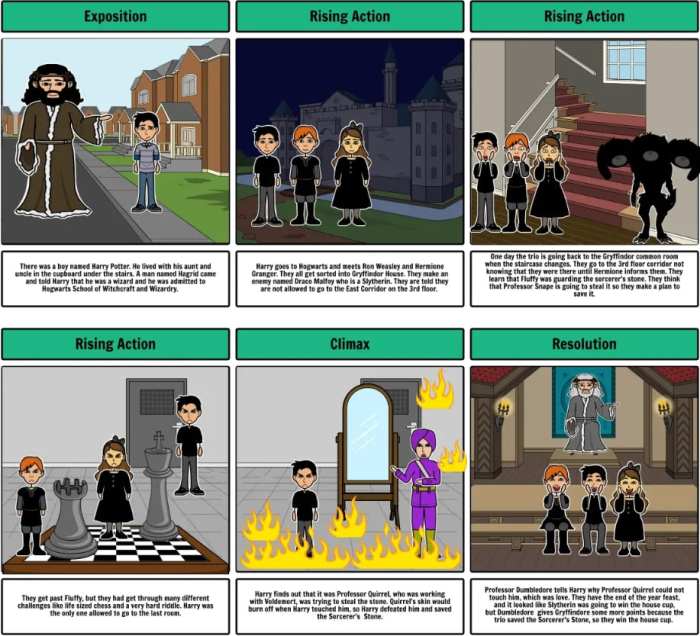
Storyboarding is a powerful tool for visualizing character development and emotional arcs. By focusing on visual cues, we can effectively communicate complex internal states without relying solely on dialogue. These exercises aim to strengthen your ability to convey emotion through visual storytelling.
Exploring character emotion through storyboard exercises enhances the narrative’s impact and allows for a deeper understanding of character motivations and reactions. Effective visual storytelling relies on conveying emotions non-verbally, enhancing the audience’s engagement and comprehension.
Four Frames of Emotion
This exercise focuses on depicting a character experiencing a range of emotions – joy, sadness, anger, and fear – in a concise four-frame sequence. Each frame should clearly illustrate a distinct emotional state through changes in facial expression, body language, and even the surrounding environment.
- Frame 1 (Joy): The character is shown laughing, eyes crinkled at the corners, mouth open in a wide smile. Their body is relaxed, arms outstretched perhaps, possibly holding something they are delighted about. The background could be bright and sunny.
- Frame 2 (Sadness): The character’s head is bowed, shoulders slumped. Tears stream down their face, their mouth is downturned in a frown. The background might be muted in color and slightly blurred, suggesting a lack of focus.
- Frame 3 (Anger): The character’s fists are clenched, eyebrows furrowed, and their mouth is set in a firm line. Their body is tense, possibly leaning forward aggressively. The background might be red or otherwise visually jarring.
- Frame 4 (Fear): The character’s eyes are wide and their mouth is slightly open in a gasp. Their body is recoiling, perhaps hands raised defensively. The background might be dark and shadowy, creating a sense of unease.
Internal Conflict Through Subtle Changes
This exercise explores the subtle shifts in a character’s posture and environment to reveal an internal struggle. The character’s internal monologue provides insight into their conflicting thoughts and feelings.
- Frame 1: The character sits rigidly at a desk, hands clasped tightly. Internal Monologue: “Should I take the promotion? It’s a huge opportunity, but it means leaving everything I know behind.”
- Frame 2: The character paces restlessly, running a hand through their hair. Internal Monologue: “The pay is amazing, but the hours are brutal. Is it worth sacrificing my personal life?”
- Frame 3: The character sits slumped in a chair, head in their hands. Internal Monologue: “I’m so tired of this uncertainty. I just want to make the right decision.”
- Frame 4: The character stands looking out a window, a thoughtful expression on their face. Internal Monologue: “Maybe this is a chance to grow, to challenge myself.”
- Frame 5: The character picks up the phone, a determined look on their face. Internal Monologue: “Okay, I’m ready. Let’s do this.”
- Frame 6: The character smiles slightly, a sense of relief washing over them. Internal Monologue: “Whatever happens, I’ll have no regrets.”
Object Interaction and Emotional Response
This exercise uses a single object as a catalyst for a series of emotional responses in the character. The object’s properties and the character’s interaction with it reveal the emotional arc.
- Frame 1 (Curiosity): The character cautiously picks up a small, intricately carved wooden box. The box is old and mysterious, with ornate carvings.
- Frame 2 (Wonder): The character opens the box, revealing a beautiful antique necklace inside. Their eyes widen in amazement.
- Frame 3 (Joy): The character carefully holds the necklace, a broad smile spreading across their face. The necklace seems to hold sentimental value.
- Frame 4 (Sadness): The character traces a faded inscription on the necklace, a wave of nostalgia washing over them, perhaps remembering a loved one.
- Frame 5 (Acceptance): The character gently closes the box, a peaceful expression replacing the sadness. They have found closure.
Narrative Scene Development
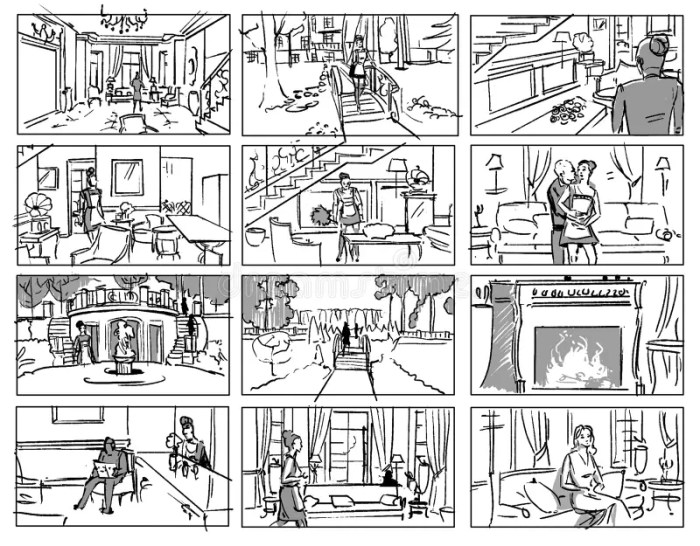
Developing compelling narratives through storyboards requires understanding how to visually convey emotion, action, and the passage of time. This section explores three distinct narrative styles – everyday life, suspense, and comedy – demonstrating how lighting, sound, camera angles, visual gags, and pacing contribute to effective storytelling. Each example provides a concise storyboard with accompanying descriptions.
Daily Life Scene Storyboard
This storyboard depicts the simple act of making coffee. The narrative arc focuses on the routine and comforting aspects of the morning ritual.
Frame 1: A close-up shot of hands reaching for a coffee grinder. Soft, warm lighting illuminates the scene. Sound: the gentle whirring of the grinder. Narrative: The quiet beginning of the day.
Frame 2: A medium shot of coffee grounds being poured into a filter. The lighting remains warm, highlighting the rich brown of the coffee. Sound: the gentle pour of water, a soft hiss as it hits the grounds. Narrative: The preparation, a familiar process.
Frame 3: A wide shot of a steaming mug of coffee sitting on a table next to a sunny window. Warm lighting emphasizes the steam. Sound: the quiet clinking of the mug, the gentle hum of morning sounds outside. Narrative: The reward, a moment of peace.
Suspenseful Scene Storyboard
This storyboard depicts a suspenseful scene where a character discovers something unsettling in their home. The narrative arc builds tension through visual cues and carefully chosen camera angles.
Frame 1: A low-angle shot looking up a darkened staircase. The only light source is a single lamp at the bottom, casting long shadows. Sound: Silence, broken only by the character’s heavy breathing. Narrative: The anticipation of something unknown.
Frame 2: A close-up shot of a hand slowly reaching for a doorknob at the top of the stairs. The shadows are deeper, creating a sense of claustrophobia. Sound: A faint creak of the door. Narrative: Building tension, approaching the unknown.
Frame 3: A medium shot from behind the character as they cautiously open the door, revealing a dark, empty room. The camera angle emphasizes their vulnerability. Sound: Silence, punctuated by a sudden, sharp noise from within the room. Narrative: The reveal of the threat, the uncertainty.
Frame 4: A high-angle shot looking down at the character, who is frozen in fear. The room is still dark, the shadows obscuring details. Sound: Accelerated heartbeat, amplified silence. Narrative: The peak of fear, a moment of paralysis.
Frame 5: A close-up shot of an object in the room – a broken window, perhaps, or a discarded weapon. The lighting slightly increases, revealing more of the room. Sound: A low, ominous hum. Narrative: The unsettling revelation, the aftermath.
Comedic Scene Storyboard
This storyboard depicts a comedic scene involving a character trying to assemble flat-pack furniture. The narrative arc relies on visual gags and the timing of actions for comedic effect.
Frame 1: A wide shot of a character surrounded by a pile of flat-pack furniture parts, looking confused. Bright, cheerful lighting. Sound: Upbeat, slightly frantic music. Narrative: The initial setup, the overwhelming task.
Frame 2: A medium shot of the character attempting to fit two pieces together, clearly in the wrong orientation. The lighting highlights their frustrated expression. Sound: A comedic “thump” as the pieces don’t fit. Narrative: The failed attempt, the escalating frustration.
Frame 3: A close-up shot of the character’s face contorted in frustration, as they realize they’ve assembled the furniture upside down. The lighting emphasizes the absurdity of the situation. Sound: A dramatic sigh, a comedic “boing” sound effect. Narrative: The comical realization of the mistake.
Frame 4: A wide shot of the character looking defeated, surrounded by the assembled, upside-down furniture. The lighting remains bright, highlighting the absurd situation. Sound: The upbeat music returns, now slightly mocking. Narrative: The anticlimactic conclusion, the humor in the failure.
Final Wrap-Up
By completing these ten storyboard warm-up exercises, you’ll not only improve your technical skills but also cultivate a more fluid and intuitive approach to visual storytelling. The exercises encourage experimentation and playful exploration, fostering a creative mindset that extends beyond the page. Remember, the key is to embrace the process, allowing your imagination to guide you through each step. The result will be a sharpened creative eye and a confident ability to translate complex ideas into dynamic visual narratives.