Mastering scene transitions is crucial for compelling storytelling. A well-crafted transition seamlessly guides the viewer through shifts in time, location, or emotion, maintaining narrative flow and impact. This exploration delves into four key strategies for storyboarding effective transitions, enhancing your ability to create visually engaging and emotionally resonant narratives.
We’ll examine diverse transition types, from jump cuts to dissolves, and explore how visual cues, color palettes, and camera angles can be strategically employed to create smooth and impactful shifts between scenes. By understanding the nuances of pacing and mood, and applying these techniques across various genres, you’ll elevate your storytelling to a new level of sophistication.
Understanding Scene Transitions
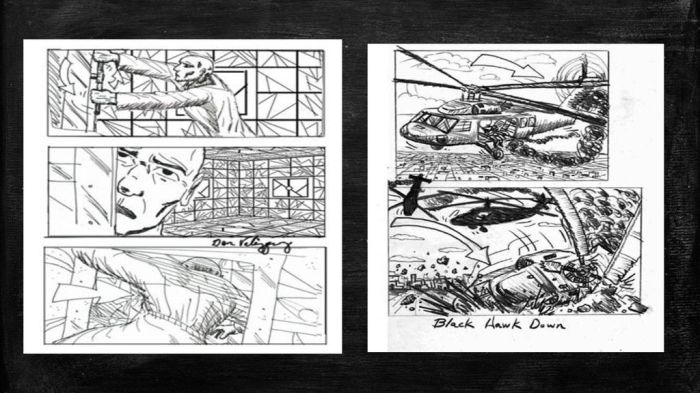
Effective scene transitions are crucial for maintaining a film’s narrative flow and enhancing its emotional impact. They dictate the pace, control the audience’s attention, and contribute significantly to the overall mood. Understanding the different types of transitions and their applications is essential for any aspiring storyboard artist.
Scene transitions are more than just cuts; they are carefully chosen cinematic tools that shape the viewer’s experience. A poorly chosen transition can disrupt the narrative, while a well-executed one can seamlessly move the story forward, highlighting key emotional shifts or changes in time and place.
Types of Scene Transitions and Their Effects
The following storyboard depicts three common types of scene transitions: a jump cut, a fade-out/fade-in, and a dissolve. Each transition impacts the pacing and mood differently.
Storyboard:
Panel 1 (Jump Cut): A close-up of a character’s face, eyes wide with shock. The next panel immediately shows the same character, but now their expression is one of relief. The background remains unchanged. This implies a short, abrupt passage of time.
Panel 2 (Fade-Out/Fade-In): A wide shot of a bustling city street fades to black. The next panel fades in on a quiet, empty country road. This transition clearly indicates a change of location and a shift in atmosphere.
Panel 3 (Dissolve): One image gradually dissolves into another. Panel 3A shows a character looking out a window at a stormy sea; Panel 3B shows the same character in bed, asleep. The storm imagery gradually transitions into the tranquil scene of sleep, visually representing a transition from external chaos to inner peace.
Effect on Pacing and Mood: The jump cut creates a fast, jarring pace, emphasizing the sudden shift in the character’s emotion. The fade-out/fade-in provides a more deliberate, smoother transition, allowing the audience to register the change in location. The dissolve offers a more poetic and suggestive transition, blending the two scenes together and emphasizing the thematic connection between the storm and the character’s sleep.
Visual Cues for Smooth Transitions
Visual cues within a storyboard are essential for seamlessly connecting scenes with differing locations or time periods. These cues can include matching action, color palettes, or specific objects. For instance, a character exiting a building in one scene could be shown entering a car in the next, providing a visual link. Similarly, using consistent color schemes or recurring props across scenes can subtly create a sense of continuity, even when the settings are drastically different. Changes in lighting can also signal a passage of time, for example, a shift from bright sunlight to the soft glow of twilight.
Using Montage for Condensing Time
A montage is a powerful tool for compressing a significant amount of time into a concise sequence. The following storyboard sequence illustrates a character’s training montage, condensing several weeks into a few short scenes.
Storyboard Sequence:
Panel 1: Character struggling with basic exercises.
Panel 2: Character improving technique, slight sweat visible.
Panel 3: Character performing advanced exercises with ease.
Panel 4: Character confidently executing a final, complex maneuver.
| Panel | Time Elapsed | Action | Visual Cue |
|---|---|---|---|
| 1 | Week 1 | Struggling with basic exercises | Frustrated expression |
| 2 | Week 2-3 | Improving technique | Increasingly confident body language |
| 3 | Week 4-5 | Performing advanced exercises | Muscles more defined, less effort shown |
| 4 | Week 6 | Mastering final maneuver | Confident and focused expression |
Storyboarding for Emotional Impact
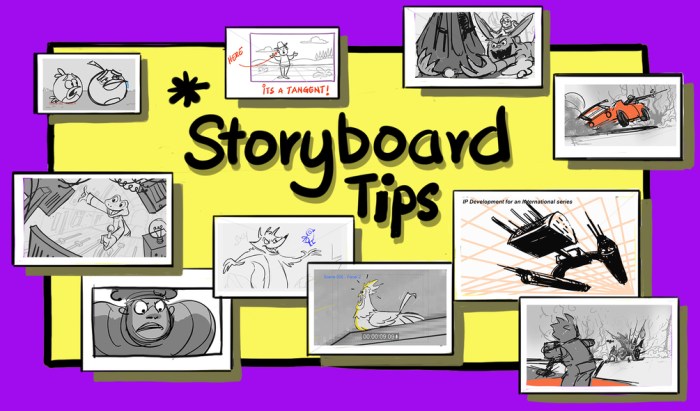
Effective storyboarding isn’t just about plotting the action; it’s about crafting the emotional journey of the audience. Mastering transitions in feeling and tone is crucial for creating a compelling narrative that resonates deeply. By carefully considering visual elements and composition, we can guide the viewer’s emotional response, ensuring a smooth and impactful experience.
Storyboarding allows for precise control over the emotional arc of a scene or sequence. This control is achieved through thoughtful manipulation of visual elements such as color, camera angles, and character placement. By strategically planning these elements, the storyboard artist can ensure a seamless transition between emotional states, enhancing the overall narrative impact.
Color Palette Transitions
Color palettes are powerful tools for subtly guiding the audience’s emotional response. A shift from vibrant, warm colors (reds, oranges, yellows) to cooler, desaturated tones (blues, greens, grays) can effectively signal a transition from joy to sadness or contemplation. For instance, imagine a scene transitioning from a bright, sunny picnic (saturated yellows and greens) to a character sitting alone at dusk (muted blues and purples). The color change subtly mirrors the emotional shift from happiness to loneliness. Similarly, a scene filled with bright, saturated colors might suggest excitement and energy, while a scene dominated by muted, dark tones might evoke feelings of fear or mystery. The use of contrasting color palettes can highlight the emotional differences between scenes and enhance the impact of the narrative.
Camera Angles and Character Positioning for Emotional Shifts
Camera angles and character positioning are equally important in conveying emotional shifts. Consider a scene where a character experiences a sudden loss. We can begin with a high-angle shot showing the character laughing and interacting with others in a joyful setting. The use of a high angle here can establish a sense of vulnerability and even foreshadow a fall. The following panels could then progressively shift to lower angles, perhaps a medium shot showing a subtle change in expression, and finally a low angle shot depicting the character alone, overwhelmed by grief, emphasizing their powerlessness. This change in angle subtly reflects the shift in their emotional state. The character’s positioning also plays a crucial role. An isolated character positioned in the corner of the frame, contrasted against a wide shot of the celebratory event, can emphasize their isolation and grief even further.
Storyboard Example: Joy to Somber
Let’s illustrate a transition from a joyful scene to a somber one.
Panel 1: Wide shot. A brightly lit park, children playing, adults laughing, warm sunlight. Colors are vibrant yellows, oranges, and greens. The overall composition is dynamic and energetic.
Panel 2: Medium shot. A young girl, the protagonist, is laughing and playing with a ball, her face radiant. The colors remain bright, but focus is shifted to her.
Panel 3: Close-up. The girl’s face is shown, still smiling but with a hint of worry in her eyes. The colors start to become slightly less saturated.
Panel 4: Medium shot. The girl is sitting alone on a bench, the park now mostly empty and shrouded in twilight. The colors are muted blues and purples. Her posture is slumped.
Panel 5: Close-up. The girl’s face is now etched with sadness. The color palette is predominantly dark blues and grays. Her expression is clearly mournful. The lighting is dim and emphasizes the shadows on her face.
Practical Applications

Storyboarding transitions effectively isn’t just about understanding the theory; it’s about applying that knowledge across diverse storytelling genres. The approach to transitions varies significantly depending on the desired emotional response and the overall tone of the scene. This section will explore how transitions function differently in comedy, drama, action, and suspense, providing concrete examples to illustrate these differences.
The choice of transitions directly influences the audience’s experience, shaping their emotional journey and understanding of the narrative. A smooth, slow transition might build suspense, while a rapid cut could emphasize chaos or excitement. Understanding this relationship is crucial for effective storyboarding.
Transitions in Comedic and Dramatic Scenes
Comedic scenes often utilize abrupt transitions, quick cuts, and unexpected juxtapositions to enhance the humor. For example, a comedic scene might transition from a character tripping over a banana peel (shot 1) to a close-up of their shocked expression (shot 2), followed immediately by a wide shot revealing a group of onlookers laughing (shot 3). This rapid sequence of events creates a surprising and humorous effect. In contrast, dramatic scenes typically employ slower, more deliberate transitions. A dramatic scene might transition from a character’s pensive face (shot 1), slowly panning to a significant object in the background that reveals a crucial plot point (shot 2), then cutting to a reaction shot emphasizing their emotional response (shot 3). This gradual unveiling of information builds tension and emotional impact.
Storyboarding an Action Scene
Consider a car chase scene. The storyboard would emphasize rapid cuts and dynamic camera movements to create a sense of urgency and excitement.
- Shot 1: Wide shot – The car speeds around a corner, tires screeching. The camera angle is slightly low, emphasizing the car’s speed.
- Shot 2: Close-up – The driver’s intense, focused expression.
- Shot 3: Point-of-view shot – From the driver’s perspective, blurring the background to enhance the speed.
- Shot 4: Quick cut – A collision with another vehicle, shown from multiple angles.
- Shot 5: Extreme close-up – A detail of the damaged car, emphasizing the impact.
- Shot 6: Wide shot – The chase continues, with the car weaving through traffic. The camera follows the car, using a tracking shot.
The quick cuts and dynamic camera movements create a visceral sense of speed and danger, mirroring the character’s experience and keeping the audience engaged.
Storyboarding a Suspenseful Scene
In a suspenseful scene, carefully chosen transitions and pacing are crucial for building anticipation and tension. Consider a scene where a character is alone in a dark house, hearing strange noises.
- Shot 1: Long shot – The character enters the dimly lit house, creating an unsettling atmosphere. The transition is a slow dissolve from a brightly lit exterior.
- Shot 2: Medium shot – The character cautiously explores a room, their face illuminated only by a flickering light source. The transition is a smooth push-in.
- Shot 3: Close-up – The character’s hand grips a weapon, their expression showing increasing fear. The transition is a quick cut, emphasizing the sudden realization of danger.
- Shot 4: Point-of-view shot – A shadowy figure is glimpsed at the edge of the frame, disappearing quickly. The transition is a quick cut to a reaction shot, showing the character’s startled expression.
- Shot 5: Medium shot – The character searches for the source of the noise, their movements tense and hesitant. The transition is a slow zoom, drawing the viewer’s attention to specific details.
The use of slow transitions and deliberate pacing initially creates a sense of unease, followed by quick cuts to emphasize moments of surprise and fear, building the suspense effectively.
Epilogue
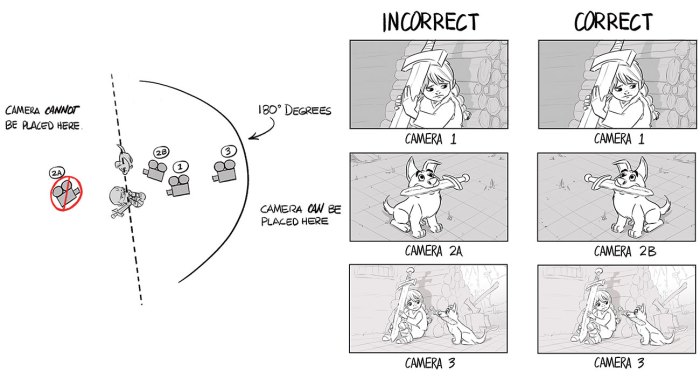
Storyboarding effective transitions is not merely a technical skill; it’s an art of visual storytelling. By thoughtfully considering the type of transition, its impact on pacing and mood, and its application within the specific genre, you can craft narratives that are both engaging and emotionally resonant. Mastering these techniques empowers you to create compelling visual stories that captivate your audience and leave a lasting impression. Experiment with these strategies, refine your approach, and discover the power of seamless transitions in your own storytelling.