Mastering dynamic posing is crucial for creating compelling anime storyboards. This guide delves into eight key techniques, transforming static images into vibrant narratives. We’ll explore fundamental posing principles, examining the interplay of body language and perspective to effectively convey emotion and narrative. Then, we’ll move into advanced techniques like foreshortening and overlapping action, showcasing how to create impactful and memorable scenes.
From understanding the power of silhouettes to conveying speed and weight in character movements, we’ll equip you with the skills to elevate your anime storyboarding to a new level. We’ll also analyze different anime styles and how posing techniques adapt to each, ensuring your work reflects the unique aesthetic you aim for. Prepare to transform your storyboards from static frames to dynamic, emotionally resonant sequences.
Fundamental Posing Principles for Anime Storyboards

Effective posing is crucial in anime storyboarding, serving as a powerful visual language to convey narrative and emotion. A well-executed pose can instantly communicate a character’s internal state and their relationship to the surrounding environment, significantly enhancing the storytelling impact. Understanding the principles of posing allows storyboard artists to create dynamic and engaging visuals that effectively communicate the intended message.
Body Language and Perspective in Anime Storyboarding
Body language plays a vital role in conveying emotion and narrative. The subtle tilt of a head, the position of hands, and the overall posture all contribute to the character’s expression. For instance, slumped shoulders and a downturned head might suggest sadness or defeat, while a rigid posture and clenched fists could indicate anger or determination. Perspective also significantly impacts the viewer’s interpretation. A low-angle shot looking up at a character can make them appear powerful or intimidating, while a high-angle shot looking down can make them seem vulnerable or insignificant. The strategic use of these elements allows storyboard artists to guide the viewer’s emotional response and understanding of the scene.
Dynamic vs. Static Poses
Dynamic poses are characterized by movement and energy. They often feature implied motion, suggesting action and dynamism. A character leaping through the air, running, or engaging in a fight are all examples of dynamic poses. These poses are typically more visually engaging and capture the viewer’s attention more effectively. In contrast, static poses convey stillness and stability. A character standing calmly, sitting thoughtfully, or simply observing their surroundings are examples of static poses. While less visually stimulating than dynamic poses, static poses can be incredibly effective in conveying specific emotions or creating a sense of calm amidst the action. The skillful use of both dynamic and static poses allows for a more varied and engaging visual narrative.
Storyboard Panels Demonstrating Emotions Through Body Language
The following table showcases three storyboard panels depicting anger, joy, and sadness using only body language:
| Emotion | Panel Description |
|---|---|
| Anger | Panel shows a close-up of a character’s face, their brows furrowed, eyes narrowed, and fists clenched tightly. Their body is tense, shoulders hunched, and jaw set. The background is blurred, emphasizing the character’s intense emotional state. |
| Joy | Panel depicts a character with their arms raised in the air, a wide, open-mouthed smile on their face, and eyes sparkling with happiness. Their body is relaxed and leaning slightly back, suggesting carefree exuberance. The background might show a celebratory event or a beautiful landscape. |
| Sadness | Panel shows a character sitting hunched over, their head bowed low, and shoulders slumped. Their arms are wrapped around their knees, and their overall posture conveys dejection. Their face is partially obscured, suggesting a desire for privacy. The background could be muted and somber, reflecting their emotional state. |
Utilizing the Line of Action to Create Dynamic Poses
The line of action is a conceptual line that runs through the character, indicating their implied movement and overall posture. It acts as a guide for creating visually appealing and dynamic poses. By strategically positioning the line of action, storyboard artists can create a sense of flow and movement, even in static poses. A curved line of action suggests fluidity and grace, while a straight line might indicate strength and determination. The effective use of the line of action helps to unify the character’s pose and creates a more cohesive and visually engaging image. For example, a character running would have a strongly diagonal line of action, emphasizing the forward momentum, while a character in a relaxed pose might have a more gently curving line.
Advanced Techniques for Dynamic Posing in Anime Storyboards
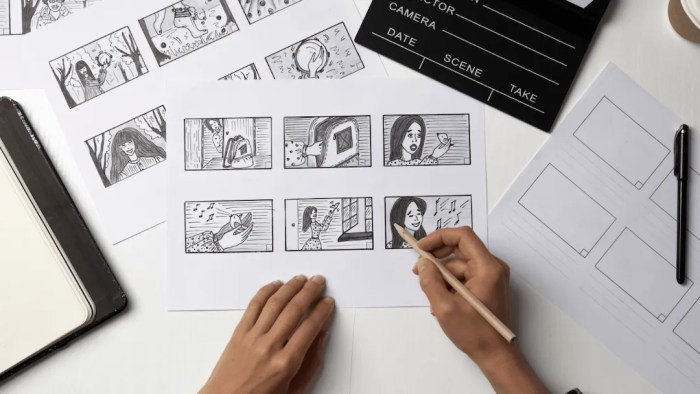
Building upon fundamental posing principles, this section delves into more advanced techniques crucial for creating dynamic and impactful action sequences in anime storyboards. Mastering these techniques elevates your storytelling capabilities, allowing you to convey emotion, power, and narrative momentum with greater precision. We’ll explore the nuanced use of exaggeration, foreshortening, overlapping action, and silhouette to achieve visually stunning results.
Exaggerated versus Realistic Poses in Anime Action Sequences
Exaggerated and realistic poses serve distinct purposes in anime action sequences. Realistic poses, while grounded in anatomical accuracy, can sometimes lack the visual punch needed to capture the intensity of a fight scene. Exaggerated poses, on the other hand, emphasize movement, emotion, and impact, often pushing beyond the limits of human anatomy to create a more stylized and dramatic effect. The choice between these styles depends on the overall tone and style of the anime. A more realistic approach might suit a grounded, dramatic series, while exaggerated poses are frequently found in action-packed, high-energy shows. For example, a realistic depiction of a punch might show a clenched fist connecting with a target. An exaggerated version might show the fist engulfed in a burst of energy, or the impact causing a visible shockwave.
Foreshortening to Create Depth and Impact
Foreshortening, the technique of depicting objects or figures at an angle to create the illusion of depth and perspective, is a powerful tool for dynamic posing. By shortening the length of limbs or body parts that are closest to the viewer, and elongating those further away, animators can create a sense of three-dimensionality and enhance the feeling of speed and movement. Consider a character running towards the viewer: their legs closest to the camera will appear shorter and wider, while their legs further away will be elongated and thinner. This creates a sense of depth and movement that a flat, two-dimensional pose cannot achieve. Many renowned anime, such as *Akira* and *Ghost in the Shell*, expertly utilize foreshortening to create impactful and visually arresting scenes.
Storyboard Sequence: Overlapping Action in a Jump Kick
Overlapping action is a crucial animation principle that adds realism and dynamism to movement. It involves having different parts of a character’s body move at slightly different times, creating a more fluid and believable action sequence. This prevents the character from appearing stiff or robotic. The following storyboard sequence illustrates this technique in a jump kick:
- Panel 1: The character is crouched, legs slightly bent, arms pulled back, preparing for the jump. The focus is on the tension in the muscles.
- Panel 2: The character launches upward. The legs are extended, while the arms are still in the process of moving forward, creating a sense of motion.
- Panel 3: The character is airborne. One leg is fully extended towards the target, while the other leg is still slightly behind, indicating the ongoing movement.
- Panel 4: The leg connects with the target, creating a powerful impact. The other leg is now almost fully extended, showing the follow-through of the movement. The character’s torso is slightly twisted, emphasizing the force of the kick.
- Panel 5: The character lands, their body slightly leaning forward, demonstrating the impact of the kick. The arms are now swinging downward to maintain balance.
The Role of Silhouette in Creating Strong Poses
The silhouette of a character, or the Artikel of a figure viewed against a light background, plays a significant role in creating strong and memorable poses. A well-designed silhouette can instantly convey a character’s attitude, action, or emotion even without detail. A broad, powerful silhouette can suggest strength and dominance, while a smaller, more delicate silhouette might convey vulnerability or grace. Many iconic anime characters, such as Goku from *Dragon Ball Z* or the various mecha from *Gundam*, have instantly recognizable silhouettes that contribute significantly to their visual appeal and memorability. The use of strong silhouettes allows for clear communication of the action even in quick shots or at a distance, adding to the dynamism of the overall scene.
Storyboarding Techniques to Enhance Anime Action and Emotion
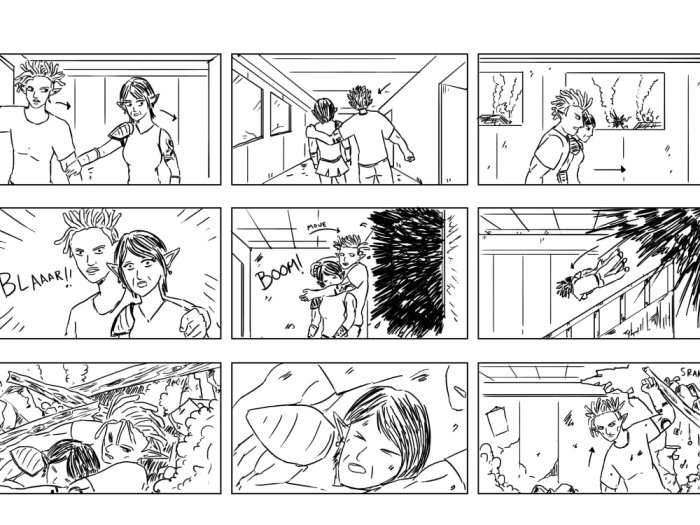
Effective storyboarding is crucial for conveying the dynamism and emotional depth inherent in anime. By carefully considering character posing, camera angles, and the overall flow of action, storyboard artists can significantly impact the viewer’s experience, creating scenes that are both visually stunning and emotionally resonant. This section will explore specific techniques to achieve this.
Conveying Speed and Impact in Fight Scenes
Dynamic fight scenes rely heavily on the interplay between posing and camera work. To depict speed, utilize exaggerated poses that emphasize motion blur, often achieved through streaking lines or blurred limbs. Rapid camera movements, such as quick cuts or whip pans, further enhance the sense of urgency and chaos. Impact is best conveyed through contrasting poses: a powerful, impactful pose immediately before the hit, followed by a dramatic reaction pose showing the effect of the blow. Consider using slow-motion sequences at critical moments to amplify the impact and allow the audience to fully appreciate the force involved. Wide shots can establish the context of the fight, while close-ups focus on the characters’ expressions and the intensity of the action.
Anime Character Design Styles and Posing Variations
Different anime styles necessitate varied approaches to posing. The style significantly influences the character’s proportions, linework, and overall aesthetic, which directly impacts how poses are designed to be both effective and visually consistent with the show’s style.
| Style | Description | Posing Characteristics | Example |
|---|---|---|---|
| Super Deformed (SD) | Exaggeratedly cute and chibi-like characters with large heads and small bodies. | Simple, expressive poses with emphasis on large, expressive eyes and exaggerated movements. Poses are often less detailed and more focused on conveying emotion. | Imagine a character with a large head and small body, jumping in the air with arms and legs splayed wide, a huge grin on their face. The pose is simple but conveys great joy and energy. |
| Realistic | Characters with more natural proportions and detailed anatomy, often seen in more mature or serious anime. | Poses are more nuanced and realistic, reflecting natural human anatomy and movement. Emphasis on anatomical correctness and believable weight distribution. | Picture a character in a tense standoff, their body slightly angled, weight balanced on one leg, a hand gripping a sword, muscles subtly tensed, conveying readiness for action. |
| Shojo/Shonen | Styles that range from highly stylized to more realistic depending on the series, but often feature dynamic and expressive characters. | Poses are dynamic and expressive, often emphasizing action and movement. While not always perfectly realistic, they strive for a sense of fluidity and grace. | Visualize a character performing a powerful martial arts kick, with the body arched and limbs extended in a dramatic, almost balletic pose. The pose is fluid and showcases both strength and athleticism. |
Creating Weight and Impact in Character Movements
To effectively illustrate weight and impact, consider the character’s body language and the environment. For example, a falling character should not simply plummet straight down. Instead, their body might twist slightly as they fall, limbs flailing, hair streaming behind them. The pose should suggest the force of gravity and the impact of the fall. Clothing might ripple and billow realistically, adding to the sense of motion. The character’s facial expression, whether it’s one of shock, pain, or determination, further enhances the emotional impact of the scene. Consider the impact point; is the character hitting a hard surface or something softer? The impact point would significantly affect the pose. For example, a character falling onto a hard stone floor would have a more rigid, compact pose than one falling onto soft earth.
Storyboarding an Emotional Transformation
A storyboard depicting a character’s emotional transformation would begin with a pose and expression reflecting their initial state, perhaps sadness or anger. As the story progresses, their poses gradually shift, reflecting the evolving emotions. For instance, a character initially slumped and dejected might slowly begin to straighten up, their head lifting higher, a flicker of determination in their eyes. Facial expressions would be crucial: a slight tightening of the jaw, a determined set to the mouth, a widening of the eyes. The final pose would be a stark contrast to the initial one, reflecting their transformed emotional state – possibly defiance, resolve, or acceptance. The camera angles could also shift to mirror the emotional journey, starting with a low angle emphasizing vulnerability, then shifting to a higher angle, showcasing newfound strength.
Closure
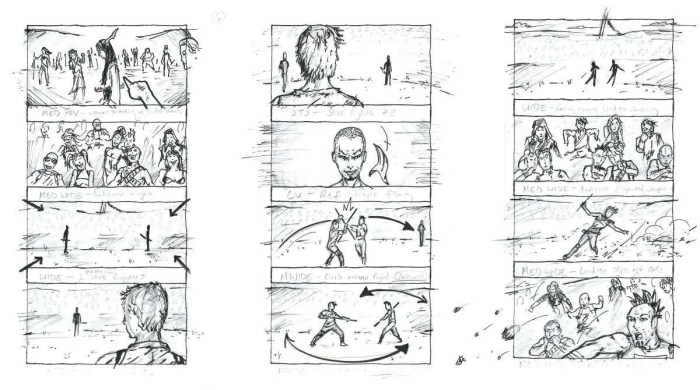
By mastering these eight techniques, you’ll be able to breathe life into your anime storyboards. From understanding fundamental posing principles to employing advanced techniques like foreshortening and silhouette manipulation, you’ll be equipped to create visually stunning and emotionally impactful scenes. Remember that practice is key; experiment with different poses, styles, and perspectives to find your unique voice as a storyboard artist. The journey to creating captivating anime is one of constant learning and creative exploration. Embrace the process, and let your imagination run wild!