Transforming a nascent idea into a compelling visual narrative requires careful planning. Storyboarding, a crucial pre-production step, allows filmmakers and creators to visualize their project’s flow, refine its emotional impact, and identify potential challenges before committing to production. This guide provides four key tips to effectively storyboard your dream project, ensuring a cohesive and engaging final product.
By focusing on defining your vision, structuring the story, refining the visuals, and considering the overall impact of sound design, you can create a robust storyboard that serves as a roadmap for your creative journey. Each step builds upon the previous one, ensuring a clear and consistent path from concept to completion. This process is vital for maintaining creative control and achieving your artistic vision.
Defining Your Vision
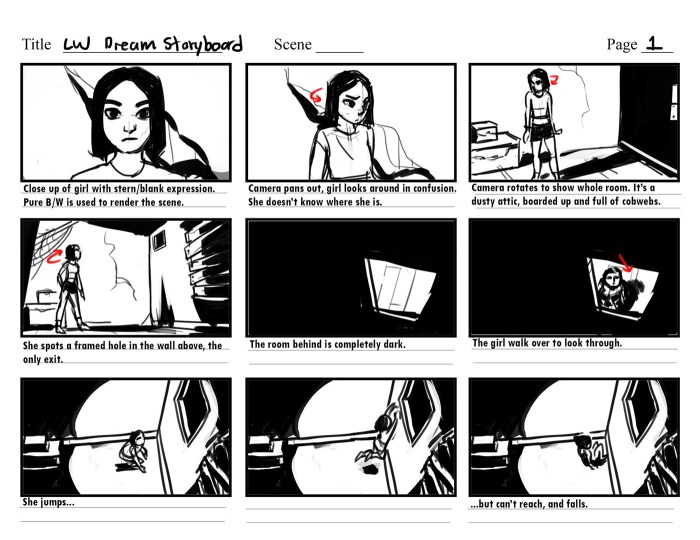
Crafting a compelling narrative is paramount to storyboarding your dream project. A strong vision guides every creative decision, from character design to scene composition. By clearly defining your project’s core concept and emotional arc, you lay the foundation for a cohesive and engaging storyboard.
A successful storyboard isn’t just a series of images; it’s a visual representation of your story’s heart. This section will guide you through defining your vision, ensuring your storyboard accurately reflects your project’s essence.
Core Concept
My dream project’s core concept is: A young, aspiring artist overcomes crippling self-doubt to finally share their work with the world, discovering unexpected joy and community in the process.
Three Defining Scenes
Three scenes encapsulate the emotional arc:
1. The Struggle: The artist sits alone in their dimly lit studio, surrounded by unfinished canvases and crumpled sketches, tears staining their cheeks. The room is cluttered, reflecting their inner turmoil. This scene represents the nadir of their self-doubt.
2. The Breakthrough: Bathed in the warm glow of a setting sun, the artist stands proudly before a completed masterpiece. Their expression is one of exhilaration and newfound confidence. The studio is now organized, reflecting their inner peace. This represents the turning point.
3. The Sharing: The artist stands at an art exhibition, surrounded by admiring viewers. Their face radiates warmth and happiness as they connect with others who appreciate their work. The scene is filled with bright, vibrant colors and positive energy. This represents the culmination of their journey.
Mood Board
The visual style will be a blend of realism and impressionism. The color palette will be primarily warm, with earthy tones like terracotta, burnt orange, and deep ochre, punctuated by vibrant bursts of turquoise and emerald green to symbolize moments of hope and growth. The overall aesthetic aims for a feeling of intimacy and vulnerability, contrasted with moments of radiant joy and self-acceptance. Imagine the texture of rough canvas, the soft glow of natural light filtering through a window, and the vibrant energy of a bustling art exhibition.
Scene Breakdown
| Scene | Setting | Characters | Key Emotion |
|---|---|---|---|
| The Struggle | Dimly lit, cluttered art studio | Aspiring artist | Despair, self-doubt |
| The Breakthrough | Art studio bathed in sunset light | Aspiring artist | Exhilaration, confidence |
| The Sharing | Busy art exhibition | Aspiring artist, art viewers | Joy, connection |
Structuring the Story

Storyboarding isn’t just about individual images; it’s about crafting a compelling narrative flow. Understanding how to structure your story visually is crucial for effectively conveying your vision to others and for your own creative process. This involves identifying key plot points, choosing an appropriate structure, and organizing scenes into acts to build dramatic tension.
This section will guide you through the process of visualizing the sequence of events in your project, enabling you to create a storyboard that is both engaging and easy to follow. We’ll explore different story structures and demonstrate how to map out the progression of events using a flowchart.
Key Plot Points and Chronological Order
Identifying the key plot points is the foundation of any successful story. These are the pivotal moments that drive the narrative forward and contribute most significantly to the overall plot. For example, in a superhero film, key plot points might include the hero’s origin story, their first encounter with the villain, a major conflict, a turning point, and the final confrontation. Listing these chronologically provides a clear roadmap for your storyboard. Think of it as creating a skeletal structure before adding the flesh and detail of individual scenes.
Alternative Story Structures: Linear, Non-Linear, Flashback
Three common story structures are linear, non-linear, and flashback. A linear structure presents events chronologically, from beginning to end, providing a straightforward and easy-to-follow narrative. This is effective for simpler stories where a clear progression is desired. A non-linear structure jumps between different timelines or perspectives, often creating suspense or revealing information gradually. This is well-suited for complex narratives or those aiming for a more disorienting effect, such as in films like *Pulp Fiction*. A flashback structure inserts scenes from the past into the present narrative, providing context or backstory. This is useful for adding depth to characters or explaining crucial events. The effectiveness of each structure depends heavily on the nature of the story being told. A linear structure may feel predictable for a complex story, while a non-linear structure might be confusing if not handled skillfully.
Organizing Scenes into Acts
Dividing your story into acts helps to build dramatic tension and create a clear narrative arc. Each act typically has its own purpose and culminates in a climax. For example, a three-act structure might consist of a setup (Act I), confrontation (Act II), and resolution (Act III). The purpose of Act I is to introduce characters, setting, and the central conflict. The climax of Act I might be a significant event that propels the narrative forward. Act II develops the conflict, introduces obstacles, and builds tension towards the climax of the story. The climax of Act II is usually the most dramatic point of the story, a major turning point. Act III resolves the conflict, offering a resolution or denouement. The climax of Act III is the final resolution of the central conflict. The number of acts can vary depending on the length and complexity of the story.
Flowchart of Events
A flowchart visually represents the progression of events within your project. This provides a clear overview of the story’s structure and helps to identify potential pacing issues or plot holes.
- Initial Setup: Introduce main characters and setting.
- Inciting Incident: An event that sets the story in motion.
- Rising Action: A series of events that build tension.
- Climax: The peak of the conflict.
- Falling Action: Events that follow the climax.
- Resolution: The conflict is resolved.
This flowchart, while simplified, illustrates how to visually represent the flow of events. More complex projects would require a more detailed flowchart, potentially with branching paths to represent alternative scenarios or plot lines. Remember, the flowchart is a tool to help you visualize and organize your story, not a rigid constraint.
Refining the Visuals
Bringing your storyboard’s visuals to life is crucial for effectively communicating your story’s essence. A well-executed visual plan ensures that your narrative resonates with the audience on an emotional and visceral level, translating your written script into a captivating visual experience. Careful consideration of character design, camera angles, lighting, and overall visual style will significantly enhance the impact of your project.
Key Scene Illustrations
To illustrate the power of visual storytelling, let’s consider three key scenes from a hypothetical fantasy adventure. Scene one: Our protagonist, Elara, a fierce warrior with fiery red hair cascading down her armor, stands atop a crumbling castle wall at dawn. The camera angle is low, emphasizing her imposing stature against the vast, misty landscape. The lighting is soft, highlighting the golds and oranges of the sunrise, casting long shadows that accentuate the texture of the ancient stone. Scene two: A tense confrontation in a dimly lit tavern. Elara, now seated at a rough-hewn table, faces a shadowy figure across from her. The camera uses a close-up shot, focusing on the characters’ intense expressions. The lighting is primarily from a single flickering candle, creating a dramatic chiaroscuro effect, emphasizing the tension. Scene three: Elara, victorious, stands amidst a field of wildflowers after a hard-fought battle. The camera angle is high, showing her surrounded by the beauty of nature, her armor slightly tarnished but her spirit unbroken. The lighting is bright and airy, emphasizing the feeling of peace and accomplishment.
Visual Style Examples
Different visual styles can dramatically impact the overall tone and feel of your project. A realistic style, with detailed character models and highly accurate environments, would lend itself to a gritty, grounded narrative. Conversely, a stylized approach, using exaggerated proportions and vibrant colors, could create a whimsical or fantastical atmosphere. Finally, a minimalist style, utilizing simple shapes and limited color palettes, could create a sense of elegance or starkness, depending on the application. The choice depends entirely on the desired mood and aesthetic of your project. For example, a realistic style might suit a historical drama, while a stylized approach would be ideal for a children’s animated film, and minimalism might enhance a science fiction story with a focus on technology.
Storyboard Panel: Crucial Moment
A crucial moment of revelation occurs when Elara discovers a hidden map within an ancient locket. The storyboard panel would depict a close-up of her face, her expression a mixture of surprise and dawning understanding. The locket, open to reveal the intricately drawn map, is positioned prominently in the foreground. The background is blurred, drawing the viewer’s attention to Elara’s emotional response. The overall mood is one of suspense and anticipation, hinting at the challenges and adventures that lie ahead. The composition uses the rule of thirds, placing Elara slightly off-center to create a more dynamic and engaging image.
Sound Design and Music’s Contribution
Sound design and music are integral to enhancing the emotional impact of your project. For example, the sounds of wind whistling through the castle ruins in the first scene would amplify the sense of loneliness and isolation. The clash of steel and the muffled grunts of combatants in the tavern scene would heighten the tension. Finally, a soaring orchestral score during the final scene would emphasize Elara’s triumph and the hope for the future. Strategic use of sound effects and music can elevate even the simplest visuals, creating a truly immersive and unforgettable experience for the viewer.
Final Summary

Successfully storyboarding your dream project involves a blend of creative vision and meticulous planning. By clearly defining your narrative, structuring the story logically, refining the visual elements, and incorporating sound design considerations, you lay a solid foundation for a successful production. This process, though demanding, ensures a cohesive and impactful final product, bringing your creative vision to life with clarity and precision. Remember, the storyboard is not just a visual aid; it’s a dynamic tool that guides and enhances your entire creative process.