Mastering the art of storyboarding is crucial for effective visual communication across various mediums, from film and animation to video games. This guide delves into the fundamental principles of storyboarding, providing a practical framework for crafting compelling visuals that enhance narrative impact. We’ll explore the six key elements that elevate a storyboard from a simple sketch to a powerful tool for pre-visualization and collaborative storytelling.
Through detailed examples and practical exercises, you’ll learn how to design effective storyboard layouts, utilize composition and color palettes to evoke specific moods, and leverage camera angles and shots to enhance the narrative flow. This comprehensive approach equips you with the skills to translate your creative vision into a clear and concise visual language, ensuring your story resonates with your audience.
Understanding Storyboard Fundamentals
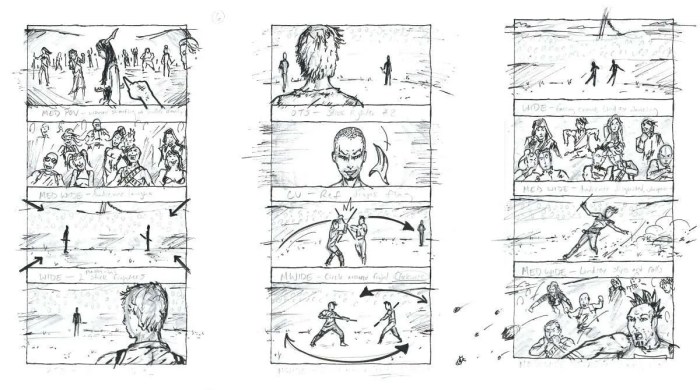
Storyboarding is a crucial pre-production process in visual communication, serving as a blueprint for any project involving moving images. It allows creators to visualize the narrative flow, camera angles, character actions, and overall visual aesthetic before committing to expensive and time-consuming filming or animation. This planning stage significantly reduces errors, improves collaboration, and helps refine the final product.
Storyboarding helps bridge the gap between a script or concept and the final visual execution. By visually representing each scene, storyboards facilitate clear communication among directors, animators, editors, and other team members, ensuring everyone is on the same page regarding the project’s visual direction. This collaborative aspect is particularly vital in large-scale projects.
Storyboard Layouts Across Different Media
Different mediums necessitate distinct storyboard layouts to reflect their unique visual characteristics and technical requirements. Film storyboards often focus on camera angles, shot composition, and character movement, utilizing a panel structure that mimics the cinematic experience. Animation storyboards, in contrast, emphasize character animation and detailed expressions, often including annotations describing specific actions and timing. Video game storyboards incorporate interactive elements, showing player perspectives, user interface (UI) elements, and branching narrative paths. They might use multiple panels to illustrate different possible outcomes based on player choices. For example, a film storyboard might depict a single shot of a character walking down a street, while an animation storyboard would break that same action into several panels showcasing different poses and movements, and a video game storyboard might show multiple panels representing different choices leading to varying scenes.
A Simple Storyboard Template
A basic storyboard template should include several key elements. Each panel should have a designated space for a visual sketch, representing the scene’s composition and action. Below the sketch, there should be space for concise descriptions of the scene’s action, dialogue, sound effects, and any other relevant details. Panel numbers are essential for maintaining sequential order. Finally, a space for notes or revisions is beneficial. Consider a template organized in columns, with each column representing a single panel. Each panel could be roughly 4 inches wide by 3 inches tall, allowing for a clear visual representation and space for written notes. This provides a manageable size while still allowing sufficient space for sketches and notes.
Examples of Effective and Ineffective Storyboards
An effective storyboard clearly communicates the visual narrative, conveying the mood, pacing, and key elements of the story. For instance, a well-executed storyboard for a dramatic scene might use dark shading and dramatic angles to enhance the emotional impact. In contrast, an ineffective storyboard might be cluttered, lack clarity, or fail to convey the intended visual style or narrative flow. A poorly executed storyboard might use unclear sketches, lack important details, or have inconsistent framing, making it difficult for the team to understand the director’s vision. For example, a storyboard for a suspenseful scene with poorly defined lighting and unclear character expressions would fail to convey the intended tension, whereas a well-executed storyboard would effectively use shadow and expression to build suspense.
Comparative Analysis of Storyboard Software
Several software options cater to storyboarding needs. Storyboarding software like Adobe Photoshop, Storyboarder, and Celtx offer varying features and functionalities. Adobe Photoshop provides extensive drawing tools but lacks specific storyboarding features. Storyboarder focuses solely on storyboarding, providing a streamlined workflow and collaborative tools. Celtx offers a more comprehensive solution, incorporating scripting, scheduling, and other pre-production tools. The choice of software depends on the project’s complexity, budget, and the team’s familiarity with specific software. For example, a large-scale animation project might benefit from the collaborative features of Celtx, while a smaller project with a focus on visual detail might find Photoshop sufficient.
Key Elements of Effective Visual Storytelling
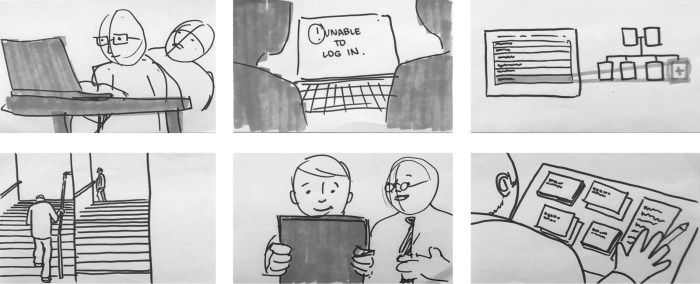
Effective storyboarding hinges on crafting visuals that not only tell a story but also resonate emotionally with the audience. This requires a deep understanding of several key elements that work in harmony to create impactful visuals. Mastering these elements elevates storyboards from simple sketches to powerful tools for pre-visualization and communication.
Composition and Visual Impact
Composition, the arrangement of elements within a frame, significantly influences the viewer’s experience. The rule of thirds, for instance, guides the placement of key subjects off-center, creating a more dynamic and engaging composition than centering everything. Leading lines, created by roads, fences, or even gaze direction, can draw the viewer’s eye to a focal point. Similarly, understanding negative space—the empty areas around the subject—is crucial; it provides visual breathing room and prevents a cluttered, confusing image. A well-composed storyboard panel directs the viewer’s attention and enhances the narrative flow. For example, placing a character in the lower third of the frame while the background dominates the upper two-thirds creates a sense of vulnerability or insignificance, adding depth to the story.
Color Palettes and Emotional Response
Color plays a vital role in evoking specific moods and emotions. Warm colors like reds and oranges often convey energy, passion, or danger, while cool colors such as blues and greens can suggest calmness, tranquility, or sadness. A predominantly blue palette might be suitable for a scene set in a serene forest, while a scene of intense conflict might benefit from a palette dominated by reds and oranges. The use of contrasting colors can also create visual interest and highlight key elements, while monochromatic palettes can create a unified and cohesive feel. Consider the difference between a vibrant, saturated scene and a muted, desaturated one; each conveys a distinct atmosphere.
Camera Angles and Shots: Shaping the Narrative
Different camera angles and shots profoundly affect how a story is perceived. A high-angle shot, looking down on a subject, can portray vulnerability or insignificance, while a low-angle shot, looking up at a subject, can suggest power or dominance. Close-up shots emphasize detail and emotion, while wide shots establish setting and context. A long shot might be used to show a character’s isolation in a vast landscape, whereas a medium shot allows for more interaction and dialogue to be conveyed visually. The strategic use of these techniques significantly influences the viewer’s emotional response and understanding of the narrative. For example, a series of close-ups during a tense confrontation can heighten the drama, while a wide shot following a character’s journey across a desolate landscape emphasizes their loneliness.
Visual Techniques and Narrative Impact
| Visual Technique | Description | Impact on Narrative | Example |
|---|---|---|---|
| Rule of Thirds | Placing key elements off-center, creating visual balance. | Creates a more dynamic and engaging composition. | A character positioned slightly off-center, drawing the eye to their expression. |
| Leading Lines | Using lines to guide the viewer’s eye towards a focal point. | Directs attention and enhances storytelling focus. | A road leading towards a distant town, highlighting the character’s journey. |
| High-Angle Shot | Camera looking down on the subject. | Creates a sense of vulnerability or insignificance. | Showing a character lying on the ground, emphasizing their helplessness. |
| Low-Angle Shot | Camera looking up at the subject. | Creates a sense of power or dominance. | Showing a villain standing over a defeated hero, highlighting their triumph. |
Practical Application and Advanced Techniques
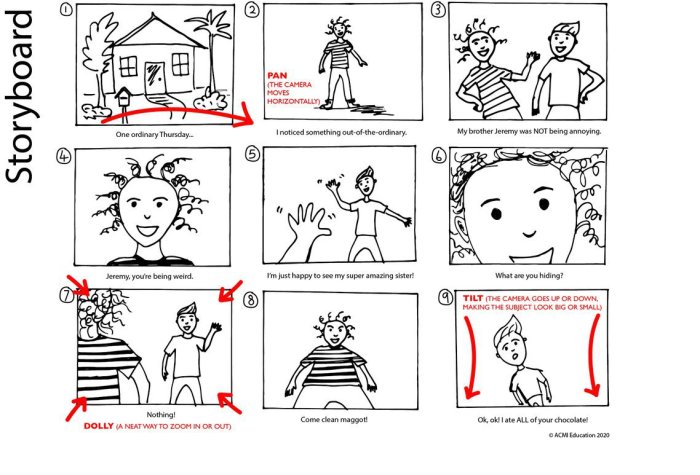
Storyboarding is not just a theoretical exercise; it’s a crucial tool for pre-visualization and communication in filmmaking, animation, and advertising. This section will explore practical applications of the six key elements discussed earlier, demonstrating how to create effective storyboards for various projects, including a simple scene, a short advertisement, and a scene with complex camera work. We’ll also delve into techniques for visually conveying character emotions and provide detailed descriptions of illustrative examples.
Storyboarding a Simple Scene
Let’s storyboard a simple scene: a young woman (Sarah) sitting in a coffee shop, reading a book. We’ll utilize the six key elements: action, dialogue, sound, setting, character, and camera angle. Panel 1 shows Sarah, from a medium shot, entering the coffee shop, carrying a book. The action is “enters coffee shop,” the dialogue is none, the sound is the gentle clinking of coffee cups and low chatter. The setting is a cozy coffee shop with warm lighting. Panel 2 shows a close-up of Sarah, sitting at a table, engrossed in her book. The action is “reading,” the dialogue is none, the sound is the quiet turning of pages. Panel 3 shows a wide shot of the coffee shop, Sarah subtly smiling at something in the book. The action is “smiles,” the dialogue is none, the sound is the ambient noise of the coffee shop. This simple example illustrates how to effectively combine all six elements in a clear and concise manner.
Storyboarding a Short Advertisement
Consider a short advertisement for a new brand of sparkling water. Panel 1: A wide shot of a person exercising outdoors on a sunny day, feeling parched. The action is “exercising, sweating,” the dialogue is none, the sound is panting and birds chirping. Panel 2: Close-up of the person reaching for a bottle of sparkling water. The action is “grabbing water,” the dialogue is none, the sound is a satisfying fizzing sound as the bottle is opened. Panel 3: Medium shot of the person taking a refreshing drink, with a look of pure satisfaction. The action is “drinking water,” the dialogue is none, the sound is the person sighing contentedly. The overall visual message is clear: the sparkling water provides refreshment and revitalization after physical activity. The use of bright, vibrant colors and active scenes helps to reinforce this message.
Storyboarding Complex Camera Movements and Transitions
This storyboard depicts a scene with a character (Mark) discovering a hidden room. Panel 1: A low-angle shot, looking up at a seemingly ordinary bookshelf. The action is “approaches bookshelf,” the dialogue is none, the sound is quiet footsteps. Panel 2: A slow zoom into a specific book on the shelf. The action is “touches book,” the dialogue is none, the sound is a faint click. Panel 3: A dramatic reveal, a wipe transition revealing a hidden doorway behind the bookshelf. The action is “doorway opens,” the dialogue is a gasp from Mark, the sound is a creaking door. This uses camera movements (zoom, low angle) and a specific transition (wipe) to create visual interest and suspense.
Conveying Character Emotions Visually
Character emotions can be conveyed effectively through body language, facial expressions, and color palettes. For example, sadness might be represented by a character slumped in a chair, with downcast eyes and muted colors. Anger could be shown through clenched fists, a furrowed brow, and intense, possibly red or dark, colors. Joy could be illustrated with a wide smile, bright eyes, and vibrant colors. The use of close-ups on facial expressions is also crucial for emphasizing emotional nuances.
Detailed Descriptions of Storyboard Illustrations
Here are descriptions of three different illustrations that could be used in a storyboard:
Illustration 1: A wide shot of a bustling city street at night, rain falling. The composition uses a leading line created by a wet street reflecting the neon lights. The color palette is dark and moody, dominated by blues, purples, and blacks, with splashes of neon. The emotional impact is one of loneliness and isolation, despite the surrounding activity.
Illustration 2: A close-up of a character’s face, showing a mixture of fear and determination. The composition focuses on the character’s eyes, emphasizing the intensity of their emotions. The color palette uses contrasting warm and cool tones, with highlights emphasizing the character’s sweat and tension. The emotional impact is one of suspense and anticipation.
Illustration 3: A high-angle shot of a group of friends laughing together in a park on a sunny day. The composition uses a shallow depth of field, focusing on the characters while blurring the background. The color palette is bright and cheerful, dominated by yellows, greens, and oranges. The emotional impact is one of joy, happiness, and camaraderie.
Outcome Summary
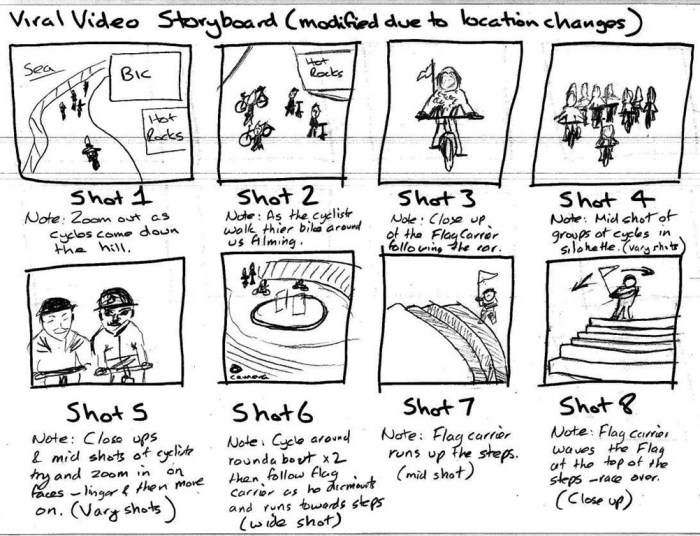
By understanding and applying the six key elements of effective visual storytelling – composition, color, camera angles, character expression, narrative flow, and overall clarity – you can transform your storyboards from basic sketches into powerful pre-visualization tools. This guide has provided you with the foundational knowledge and practical techniques to create storyboards that not only communicate your vision effectively but also inspire and engage your collaborators and ultimately, your audience. Remember, practice is key; the more you storyboard, the more refined your visual storytelling skills will become.